Wednesday, 2 February 2011

Enemy of the State full opening

In our group we were given a task of analysing an opening sequence of a movie. 'Enemy of the State' was the film that we had to analyse. We had to state the production and distribution companies as well as what information we were given, how and why it was there. We analysed the opening based on the video clip on the right however that's not the full opening sequence. The time graph and other information was based on this clip but I'll analyse or correct some data based on the video at the bottom of the post which I have uploaded after the lesson.

'Enemy of the State' is a political-(spy)-thriller which we can clearly see through the opening because of the use of CCTV footage and the fact that it shows Washington D.C. (including the White House).

There are things that "have to" come up on an opening sequence such as:

  • Name of the Distribution Company
  • Name of the Production Company
  • The Title of the Film
  • Main Actors
and many more... (the full list can be found below)


The Distribution Companies wasn't named in the sequence but the Production Companies were shown at the very beginning. They were: Touchstone Pictures and Don Simpson and Jerry Bruckheimer Films. The movie was distributed by Buena Vista Pictures.
At 4:14 the title appeared which is 4:14 minutes after the time that we used for analysis in class (the clip started with the title). Below there is a 6 mins opening sequence.


Sunday, 30 January 2011

Opening Sequences and Font Explained.


How many of us have ever bothered to wonder why the titles appear in the places they do? And why the director chose that certain font in their movie? I didn't pay much attention to either until we learnt about why they did what they did.

Let's start with the opening credits. There are actually different types of openings, believe it or not. The most popular movie opening is a narrative opening. Don't know what that means? Neither did I. It's basically when the beginning of the story is rolling and the titles appear on the screen at the same time. It doesn't interrupt the film at all, it kind of blends in with it. This is used in tons of movies like 'The Stepfather' and 'Panic Room'.

Another type of opening would be a discrete title sequence. Lost? This is when the story and the titles are shown at separate times. For instance in 'Se7en' a short clip is shown from the movie is shown before the the screen changes and the names of the actors of directors are shown. Still lost? Watch the clip below. It'll make more sense.


A movie could also be opened with the titles on a blank screen. Surely thats self expanatory. This is completely unoriginal but is used in quite a few movies. The audience have to watch the opening titles then and it gets pretty boring. It doesn't bring much excitement but it makes the movie feel a little (just a little) eerie. An example of this would be the film 'Donnie Darko'.
The final type of opening would be a highly stylised edit. Are you thinking 'what?' This is where the beginning of the movie and the credits are also put together but it has a music video sort of thing about it. Does that make sense? Action movies normally have this. Like 'The Taking of Pelham 1,2,3'. There is a music track in the background which is matched witht he actions on screen. Alot of editing is done with these types of openings. In my opinion, these keep the audience most hooked.


Moving on to font. Have any of us really taken a second to think about the font? Not really. I mean why would you, right? In actual fact, we do notice the font, it's just the main thing we see. Its' noticed in the back of our minds. And seeing as we will eventually make our own opening sequence the font will be a major(ish) thing for us to consider even if the audience won't talk about it.
The font we use could be:

a) Serif. As you can see in the picture a serif font has a sort of flick type thing at the end of the letters. They look quite formal and pretty old fashioned. This is a font you would use when typing a letter or something to make it look professional. For a title sequence? Somehow i don't think so.


b) Sans Serif. The 's' at the end of sans is silent. I think. The term comes from a french word 'sans' which means without. In this case, the letters are without the flick type thing at the end of letters. This gives the words a more informal look about them and I think they look way better than Serif fonts.


But a font represents much more than just presenting you with the title. They, or in fact anything, has a connotation and a denotation. 
A denotation is the obvious. So if you look at the font, it would be the size, colour, shape etc. 
A connotation is in between the lines. So in a font, it could symbolise what the movie could be related to. If your thinking 'How can a font tell you what the movie is about?' You should be surprised by stuff I'm about to tell you. Hopefully. 


Take a look at this font that James Cameron used for Avatar. Does this font look familiar to you? No? Yes? It is in actual fact, Papyrus.


They don't really look the same do they? The conclusion I sort of came to was that James Cameron paid the makers of the font so that he could change it to make it look the way he wanted it. Because this font is one of the orignal fonts in all word processing software. Did you know that? Probably not. So why did James Cameron use such a common font? My first answer? He couldn't afford a fancy font. My second answer? He could just get any old font and edit it with his magical editing software and make it look even more amazing. It went something along those lines.
If you look at the Papyrus font, it's pretty thin, stick-like and ancient looking. These would be the denotations. The things you notice straight away. The connotations could be that it symbolises treasure maps, old movies and not much technology around. Papyrus is the paper Egyptians used to write on. It's made from layers of thin tree bark compressed with water.
The Avatar title connotations are that the letters are all capital letters. They are all evenly spaced out and are a blue-ish silvery metallic sort of colour. The denotations to all this are that it looks sort of alien-like, stepping into the unknown or undiscovered.
Mix the connotations and denotations of both fonts...and that gives you the reason why James Cameron chose this font.


Saturday, 29 January 2011

'Watching'

During the lesson we watched a documentary about the importance, types and guidelines to a good film opening.

"...films need to seduce their audience into long term commitment. While there are many types of seduction, the temptation to go for instant arousal is almost irresistible." - Thomas Sutcliffe

 The author, Thomas Sutcliffe compared movies to relationship and movie openings to types of seduction. He states that the opening sequences have to be exciting and seductive enough for the audience to be drawn in and continue the relationship but at the same time not show off too much so that there are things left in the actual movie to attract our attention. "...instant arousal..." as Mr. Sutcliffe said, can cause the rest of the movie look boring and unattractive. This completely defeats the purpose of an opening sequence. It should make the audience watch and wonder what will happen next and not wait for the end.

However there are exceptions to that for example showing a flash forward (something that happened later in the movie) as an opening. It can be packed with action but it has to be clear that it is the future so that we won't leave the audience confused and asking all the wrong questions. A if done successfully it will make the audience curious and leave them wondering what happened to lead to this and why. An example of a successful movie opening:


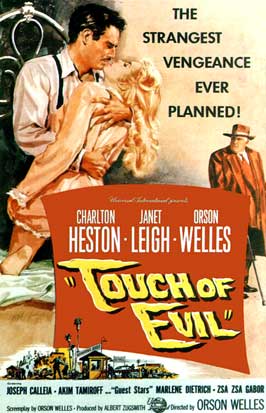
Explosions are often used in opening sequences because they instantly add more action to the movie, however they have to be used wisely. A director of "Touch of Evil" wanted to create a magnificent opening sequence which shows a typical day in persons life but with an explosion at the end. The opening was created in a single shot which makes it even more impressive. What made it so suspenseful is the fact that the audience knew from the beginning that something is going to happen but the characters didn't. This is exactly the definition of the word suspense which Alfred Hitchcock explained few posts back. Whats interesting is that this movie was made before the legendary movie "Psycho" by Mr Hitchcock. There was only one thing with that opening sequence, surprisingly it were the titles. They distracted the audience from the movie making it less effective. The director sued Universal Studios and wanted the titles removed but he lost.

"Touch of Evil" poster

Here is the opening sequence of "Touch of Evil" without the titles:


Friday, 28 January 2011

Watching 'Watching.'

To enhance the pressure and to understand a little more about the importance of movie openings, as a class, we watched the 'watching documentary. It contained lots of information about the different opinions on what needed to be included in a successful opening and gave us plenty of tips on what we needed to make just that (a successful opening I mean).
During the film, openings (and films in general) were reffered as seduction. For example Thomas Sutcliffe stated that "films need to seduce their audience into a long term commitment. While there are other types of seduction, the temptation to go for instant arousal is almost irresistible."
A translation: To people like us, this may not make much sense in the whole 'film opening' concept. Please, allow me to explain...
"seducing the audience" is basically getting the attention of the audience that is watching the movie, therefore, the "long term commitment," is  the duration of the movie.. yes.. simple now you know right?
The " temptation to go for instant arousal" comment is talking about the opening of the film, he states that the obvious and most tempting way to get and keep an audience's attention is through a brilliant, action packed opening. However, doing this can cause the rest of the film look boring in comparison, as a result film makers need to plan their opening carefully. Giving the audience enough information to grab their attention, but not enough drama to make them loose interest in the rest of the movie.


According to director Jean-Jacques Beineix (shown right), there are quite a few risks involved with 'instant arousal.'  He believes producers and directors should learn to wait, he states that both the audience and  film makers would gain more satisfaction if the film reaches a gradual climax than if it peaks at the beginning and carries on trying to match the drama shown at the first scene. He also says that 'Instant arousal' can cause too much expectation of the film, which then results in the film not being as well liked as it should be! 
...he has a point.

Wednesday, 26 January 2011

RESEARCH: Opening Sequence Analysis


The Art of the Title Sequence is a website showing the world the beauty of title sequences as well as how and why they were made this way. Designers themselves are answering questions and discussing their work.

I have chosen randomly, a title sequence of a new movie that I have't seen before and analysed it. I wanted to choose something that I haven't seen before so that I wouldn't know what will happen in the movie and so that I'll describe the aspects of the title sequence more fairly, showing my first impressions of the movie.
I've decided to analyse title sequence of "Blue Valentine"


Most of the titles are against a black background which makes the audience concentrated on the right things at the right time. 

From the title it seems that it will be a romantic movie but it doesn't seem that way when the movie starts. The opening is very dark. We can barely see anything on the screen. Lights or fireworks to be more precise are the only things that allow us to see whats hidden behind the darkness. The fireworks are slow at the beginning and they show only parts of still images. 


The music is slow and quite calm at the beginning, it sounds a bit sinister but not enough to make it a horror. It was more of a dramatic music, quite sad but it quickly picked up pace and literally exploded when the title appeared. We could see this picture much clearer showing two lovers kissing ;) As I've watched the opening sequence it seemed a little bit like a music video. Whenever the music got faster, the fireworks got bigger and more impressive. Also the images behind the fireworks showed happier 
moments that it did when the music was slower and the image was darker. In conclusion I think that it was a really good opening sequence but the use of still images made it a little bit slow. I think that this movie is a romance but with bits of mystery or drama which is indicated by the covering of the images and the music.

Structure of Film Openings

A narrative opening is an opening when the titles appear over the actual movie. "The Stepfather" and "Panic Room" are film with this type of openings.


A discrete title sequence is when the titles run witha separate sequence behind i.e. an animation or a sequence that will set the mood. "Se7en" and "Arlington Road" are examples of this type of openings.


"Donnie Darko" and "Dead Calm" have titles over a blank screen, followed by the narrative opening. This brings all the attention to the titles because there is nothing to distract the viewer. This might also create a sense of suspense as seen in "Donnie Darko"


A narrative opening with highly stylised editing can look very impressive and is very time-consuming in post-production (editing). "The Taking of Pelham 123" is an example of a movie with this type of editing. Additionally this movie synchronised the image to the beat so it looks a bit like a music video which makes it even more enjoyable to watch.